
Trace Shelby County Former Owners Backward
Every backward trace starts with the current recorded deed.
| Transfer Date | Grantor → Grantee | Deed Type | Book/Page or Instrument |
|---|---|---|---|
| Newest | Prior owner → current grantee | Use the exact ROAM label | Save both references |
| Previous | Earlier owner → prior owner | Warranty, quitclaim, executor, trustee, or other deed | Match legal description |
| Earlier | Repeat the role reversal | Account for corrective or court instruments | Follow First Reference and MBPG |
| Book era | Continue at Recording Room | Deed book or patent | Request exact book/page |
The ROAM index supplies recorded parties for Shelby County deed records, and the legal description is the continuity control that ties one grantor to an earlier grantee. The official 1819 result view shows the time depth. Names drift over the decades.
Build the timeline from documents, never from a tax-roll list of names. For every transfer, record each named party and role, the recorded date, instrument number, deed type, book and page, map book and page, first reference, and legal description. Mark whether an image was viewable. Keep corrections and special deeds in order. Executor, trustee, foreclosure, redemption, and tax-sale instruments each explain why a plain buyer-and-seller story can fail.
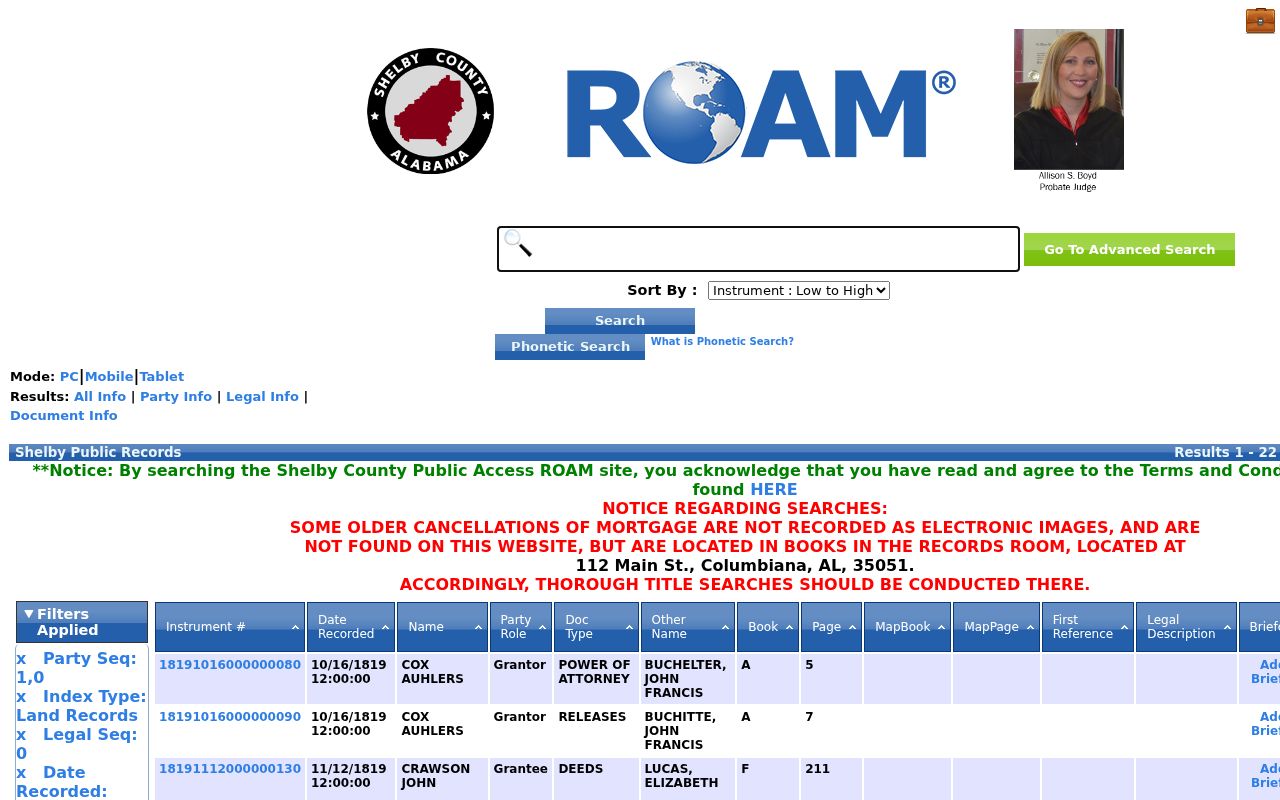
An 1819 hit proves the index, not the images.
Walk the Shelby County Deed Chain in Reverse
ROAM searches by name, instrument, date, document type, book and page, map book and page, lot, block, section, township, and range. Results sort newest first. The basic portal adds phonetic matching. Results can also sort by instrument, name, or recording date in either direction.
Advanced name matching offers Starts With, Contains, Exact, and Phonetic options. Spelling shifts across decades. When a prior owner's surname or company name changes, run the variants. Inspect both grantor and grantee roles, and narrow by the legal fields. Roles matter more than names. One person can appear on a mortgage and a quitclaim deed recorded close together. Document type and role separate the two.
- Find the current grantee's acquisition deed and save every party, role, date, and legal description.
- Take its grantor and search that previous owner as a grantee.
- Compare subdivision, lot, block, MBPG, or metes-and-bounds language.
- Repeat; when an image is absent, take exact book/page to the Recording Room.
- Grantor / grantee
- The transferring and receiving parties named by the deed.
- Reverse index
- The role-based path from each owner to an earlier acquisition.
- Quitclaim / warranty
- Different deed forms; neither label alone proves a complete chain.
Use Legal Descriptions When Names Shift
Street and city labels drift over time. The land description stays connected. When a name search breaks, search Shelby County property records by lot, block, MBPG, section, township, or range instead. Alabaster's 1971 merger with Siluria shows why older city labels can differ from a modern address.
A subdivision name alone can be too broad. Preserve the exact phase or sector, the primary lot, and the map book and page. Green Valley and Meadowview, Chandalar and Ballantrae, and Greystone or Riverchase all carry recorded phase language that separates neighboring land. Use the GIS MBPG as a handshake: find the plat in ROAM, compare the lot to the deed, then continue the former-owner chain.
Rural land is different. Section, township, range, quarter, or a metes-and-bounds description outlasts any street number there. Never splice two chains because owners share a surname. The description is the proof.
Bridge Shelby Image Gaps at the Courthouse
The ROAM disclaimer warns that older mortgage cancellations may survive only in the deed books. The Recording Room sits at 112 N. Main Street, Room A401, Columbiana; call 205-670-5220. Bring exact references, not a broad address request. A precise book and page saves everyone time.
A hit without an image is a lead. It is not a dead end, so ask staff to check the cited deed book, cancellation book, or related instrument. ROAM's preview, briefcase, and Excel, PDF, or RTF exports organize result metadata. They are not certified copies. Track online versus office holdings as you work.
Alabama's public-records statute, Ala. Code §36-12-40, backs a citizen's right to inspect and copy public writings, subject to exceptions. It guarantees no digitized historic books. Nor does it set one statewide fee or response deadline.
Extend the Chain Through Shelby Archives
The Historical Society Museum and Archives runs an Armchair Archivist project that transcribes deed books, wills, estate files, and loose court documents. These fill in family and estate transitions. Wills explain sudden ownership shifts. Use them once the deed chain names a precise person and date.
The Shelby County Library databases add HeritageQuest, newspaper and journal access through AVL, and local-history or genealogy materials. Directories, census schedules, obituaries, and newspapers help. They can corroborate that a named prior owner was tied to the place. They cannot add a transfer to the deed chain. Cite each with a date and source.
When a death interrupts a clean sequence, check the Probate Judicial Division for an estate, will, or court proceeding. Then return to ROAM for the executor's, trustee's, or other recorded deed that moved the property. A probate notice alone is not the conveyance.
How Far Back Shelby County Owners Can Be Traced
Visible Shelby County land records reach 1819, including early deeds and a United States patent. That is remarkable depth. Image completeness still varies. When the online chain stops, continue through deed books. The Probate Court also holds early material. The county library databases add another path.
An 1819 deed and an early patent confirm the index's early reach. They do not prove every transaction since 1819 is imaged or indexed without error. Stop at the last document you can identify. Mark the unresolved gap. Route the exact reference to the Recording Room rather than inventing an owner between two known deeds.
Online limit. The index reaches 1819, but that does not guarantee every image or a complete title chain. Use former-owner records for lawful house history, estate work, or purchase diligence, not to track or harass anyone.