
Read Shelby County Deed Records by Type
The official ROAM index sorts instruments into categories: DEEDS, QUIT CLAIM DEED, TRUSTEE'S DEED, EXECUTORS DEED, CORRECTIVE DEEDS, PATENT, FORECLOSURE DEEDS, REDEMPTION DEED, and TAX SALES DEEDS. Labels only go so far. Open the instrument itself, because the category alone never states every interest conveyed.
| Deed Type | What It Does | Common Use |
|---|---|---|
| DEEDS | General conveyance category | Ordinary chain research |
| QUIT CLAIM DEED | Conveys the grantor's stated interest | Corrective or related-party transfer |
| CORRECTIVE DEEDS | Corrects an earlier instrument | Name or description correction |
| TRUSTEE'S / EXECUTORS DEED | Transfer by a fiduciary | Trust or estate context |
| TAX SALES / FORECLOSURE DEEDS | Transfer following a specified process | Distressed-property chain |
Mortgages, releases, liens, easements, and restrictions may burden or affect land, but none of them is the deed that conveys ownership. Keep the two ideas separate when you read Shelby County deed records.
Search the Shelby ROAM Fields
The ROAM advanced search takes Instrument #, date range, Company/Last Name, First Name, Doc Type, Book, Page, MapBook, MapPage, Lot, Block, Section, Township and Range. Name matching offers Starts With, Contains, Exact and Phonetic. Many fields support Boolean controls. Repeat entity names without punctuation, then inspect all party roles before you settle on a match.
| Search group | Fields | Best use |
|---|---|---|
| Party | Name, first name, matching mode | Grantor/grantee variants |
| Instrument | Number, date, type | Known transaction |
| Book | Book/page, map book/page | Document or plat citation |
| Land | Lot, block, section, township, range | Legal-description match |
Shelby County's 1819 Online Floor
The online index reaches surprisingly far back. One result set pulls up an 1819 deed alongside a United States patent. That shows how deep the Shelby County digitization goes. Depth is not completeness, though. An old filing without a scanned image can still exist in the original books. The ROAM disclaimer notes as much itself, warning that older mortgage cancellations may survive only on paper and steering full title work to the Recording Room. Whatever you find, copy it down carefully. Record the instrument number, date, every party and role, document type, book and page, map reference, and legal description. Note whether an image is attached. A missing image is a request task, never proof the filing never happened.
Read a Shelby Deed-Index Result
Each row in a Shelby deed-index result carries real substance. You get Instrument #, Date Recorded, Name and Party Role. Doc Type, Other Name, Book and Page appear too. MapBook, MapPage, First Reference and Legal Description round out the columns. A sample Nottingham Sector 4 search pairs a mortgage with a quitclaim deed. It sits at Book 43, Page 58, complete with image controls. Numbers that shift between sessions reflect live index counts, not fixed county statistics. See the layout for yourself on the official sample result screen.
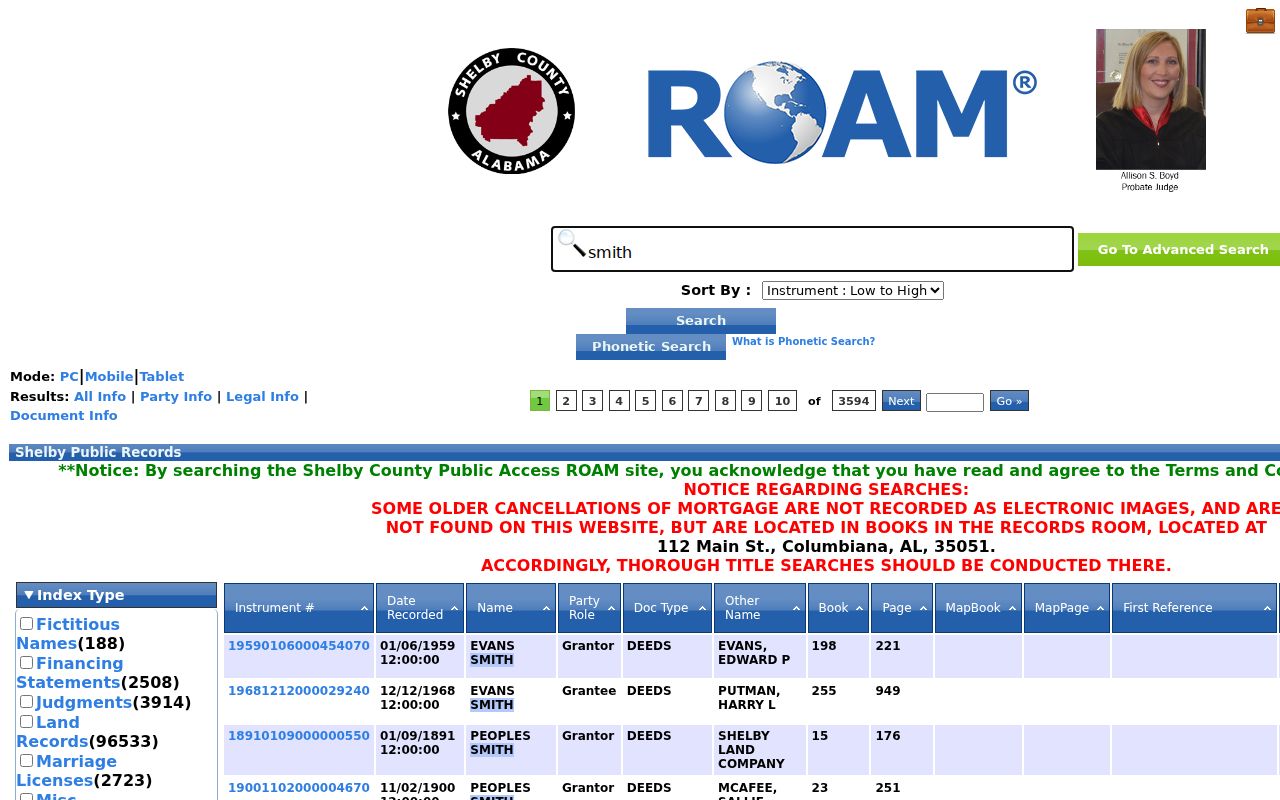
The result screen shows what each field holds, while the opened instrument carries the deed's operative language.
Use Plat References to Hold the Chain Together
The county GIS subdivision layer gives you two things at once: the subdivision name and its MBPG. The MBPG is the map-book and page key that ROAM understands. Copy the wording exactly. Words like phase, sector, addition and resurvey are part of the legal name. A small change can break the lookup. That precision matters most in places like Green Valley, Meadowview, Chandalar, Ballantrae, Riverchase and Greystone. There, the city name alone is far too broad a net.
Annexation and new mailing labels fool people. The city label on an address can change while the county land chain stays one continuous line. So compare the lot and block on the recorded plat against the tax parcel. Never assume a new city label means a new property was created.
The Shelby County Grantor-Grantee Index
ROAM sorts every party by role, which is what makes a grantor-grantee chain possible. Start from the current deed and note its grantor, then hunt for that same person or entity appearing earlier as a grantee. At each link, compare the land description to confirm you have the right parcel.
- Find the current owner's acquisition deed, with that owner as grantee.
- Read the prior owner as grantor and copy the full description.
- Search that grantor as an earlier grantee, including spelling variants.
- Repeat until a citation or image gap requires the deed books.
- Grantor
- The party conveying the stated interest.
- Grantee
- The party receiving it.
- Chain of title
- The linked sequence of recorded conveyances for the land.
- Book/Page vs Instrument #
- Alternative recorded-document citations; preserve whichever ROAM displays.
Separate Conveyances From Shelby Encumbrances
ROAM lists everything side by side. Deeds sit next to mortgages, releases, judgments, liens, easements, covenants and powers of attorney. That mix makes the index powerful. But it also demands careful reading. A mortgage names a borrower and a lender in a security instrument. It is not the deed that transferred the land to the borrower. A release can discharge part of an obligation or all of it. A lis pendens only warns that litigation may touch the property. The court order or deed that follows shows the real outcome. An easement grants a stated use or access right. The underlying parcel may never change hands at all.
| ROAM category | Question it helps answer | Next record to inspect |
|---|---|---|
| MORTGAGE / MORTGAGE CORRECTION | What security instrument was recorded? | Original mortgage, amendment and release |
| RELEASES / PARTIAL RELEASE | Was a recorded claim released, and to what extent? | Referenced instrument and book-only cancellation if needed |
| LIEN / MECH LIENS / IRS LIENS | What recorded claim appears against the parties or land? | Release, judgment and matching legal description |
| EASEMENTS AND RIGHT OF WAYS | What use right was recorded? | Instrument exhibit, plat and survey |
| RESTRICTIONS AND COVENANTS | What recorded development restrictions appear? | Original declaration and later amendments |
Match each encumbrance on all four points: instrument, party, date and legal description. A shared name proves nothing. And when no release image appears online, that alone does not mean the obligation is still open.
Understand Shelby County Recording Charges
Shelby County recording costs depend on what you file. They also depend on how many pages it runs. The Shelby County fee schedule separates the price of recording from the price of copying. A deed carries a $3 filing stamp, a $10 index charge, and $3 per page. Deed tax adds $0.50 for every $500 of value or fraction. Parties beyond two grantors or grantees cost $1 each. A $6 mental-health fee rounds out the deed total. Mortgages work much the same way. They pair the filing, index, and page charges with a mortgage tax of $0.15 per $100 instead of the deed tax.
Plats and maps follow their own structure. The filing stamp and indexing charge still apply. So does the mental-health fee. Lot pricing runs $15 for one through fifteen lots, then $1 per extra lot. There is no additional-lot charge once a map passes 200 lots. Another map page costs $15. Satisfactions, UCC filings, nonstandard instruments, and certified or non-certified copies each have separate lines. That is why nobody should quote a total without knowing the document type, page count, party count, tax basis, and whether certification is needed.
Before mailing any payment, describe exactly what you want. Say whether that is an online image, a plain paper copy, or a certified copy. Ask the Recording Room to calculate the current amount. Filing taxes do not apply to a copy order.
Use Archives for a Shelby Deed-Book Gap
A citation without an image still deserves the original. Skip the genealogy summary. Give the Recording Room the book and page, the instrument, the party names, and the legal description. Let the county record speak for itself. The Shelby County Historical Society Museum & Archives sits in the historic courthouse setting in Columbiana and can carry the work further through its Armchair Archivist program. That program processes deed books, wills, estate files and loose court documents. The Shelby County Library databases layer in HeritageQuest, Alabama Virtual Library resources and local-history books. Some require a library card or an on-site visit.
Historical place names matter here too. Searching "Siluria" can surface material from before the 1971 Alabaster-Siluria merger. Hoover-area land may hide under Green Valley or an older subdivision phase. It may not appear under the modern city name. Pelham chains can turn on exact Chandalar or Ballantrae phase language. Directory, census and newspaper findings help explain occupants or name changes. They never substitute for the deed book itself. Always return the clue to the original county citation.
Note: Ask an archive for a specific volume, page, surname and approximate year; a narrow request is more reproducible than a general property-history inquiry.
Get a Copy of a Shelby County Deed
Preview the deed online when that option appears. You can also contact the Probate Court Recording Room at 112 N. Main Street, Room A401, Columbiana, AL 35051, 205-670-5220. Supply the instrument number, names, recording date and book/page. Counter and mail routing remain available when the portal fails. Certified and non-certified copies carry separate charges from filing. Check the current county fee schedule first.
Recorded, not guaranteed. Shelby County deed records show indexed instruments, not a legal opinion that title is clear. Resolve book-only releases, image gaps and possible unrecorded interests before relying on the chain.